
Call us now :08071790210
 Send Inquiry
 Send Inquiry
Clacined Clay Calcined Kaolin
MOQ : 50 Kilograms
Clacined Clay Calcined Kaolin Specification
- Refractive Rate
- 1.56 - 1.58
- Shape
- Powder or Granular Lump
- Melting Point
- About 1750C
- Density
- 2.63 Gram per cubic centimeter(g/cm3)
- Structural Formula
- Al2O32SiO2
- Solubility
- Insoluble in water, partially soluble in acids and alkalis
- Other Names
- Calcined Clay, China Clay
- Molecular Formula
- Al2Si2O5(OH)4 (before calcining); after calcining Al2Si2O7
- Taste
- Odourless, Tasteless
- Storage
- Dry, well-ventilated place
- Purity
- Up to 99.5%
- Form
- Solid
- Molecular Weight
- 258.16 g/mol
- Smell
- Odourless
- Boiling point
- Not applicable; Sublimates at high temperature
- HS Code
- 2507
- Ph Level
- 5.0 - 6.5 (10% slurry)
- Poisonous
- No
- Classification
- Hydrated Aluminium Silicate
- Chemical Name
- Calcined Kaolin (Aluminium Silicate)
- CAS No
- 1332-58-7
- EINECS No
- 310-194-1
- Grade
- Lump/Powder (Technical, Industrial, Ceramic and Paper grades available)
- Standard
- IS: 1463:2003
- Type
- Industrial Mineral
- Usage
- Filler, Coating agent, Opacifier, Whitening agent
- Main Material
- Calcined Kaolin
- Application
- Other
- Non Toxic
- No
- Brightness
- 88 - 94% ISO
- Loss on Ignition (LOI)
- <1.5% at 1000C
- Particle Size
- D50 less than 2 microns (for powder grade)
- Whiteness
- Near to white
- Bulk Density
- 0.4 - 0.6 g/cm3 (loose)
- Oil Absorption
- 30 - 38 g/100g
- Moisture Content
- <0.5%
- Hardness (Mohs)
- 2 - 2.5
Clacined Clay Calcined Kaolin About
High-Performance Functional Mineral
Why Choose Calcined Clay?
Why Choose Calcined Clay?
- Eco-friendly cement replacement (SCM)
- Enhances strength & durability
- Improves opacity & brightness (Paints)
- Excellent rheology & bonding (Adhesives)
- Cost-effective performance enhancer
- Construction & Concrete (LC3, Green Cement)
- Paints, Coatings & Inks
- Rubber, Plastics & Polymers
- Adhesives, Sealants & Construction Chemicals
- Ceramics & Refractories
- Paper & Packaging
- Agriculture & Environmental Solutions
- High Whiteness (85-95%)
- Controlled Particle Size
- Low Moisture Content
- High Pozzolanic Reactivity
- Chemically Stable
Partner with ASTRRA CHEMICALS LLP
For sustainable & high-performance solutions
Innovating Sustainable Mineral Solutions
Superior Brightness and Whiteness
This calcined kaolin offers a remarkable brightness rating of 88-94% ISO, making it ideal for applications where high opacity and aesthetic appeal are essential. Its near-white shade enhances products across paper, plastic, paint, and ceramic industries, improving their visual quality significantly.
Exceptional Fine Particle Size
With a D50 particle size less than 2 microns for the powder grade, this product ensures a smooth finish and optimal dispersion in end-use formulations. The fine particle sizing is crucial in applications like coatings and ceramics to achieve desired surface properties.
Versatile Industrial Applications
Calcined Clay is trusted across various sectors-including paper, paints, rubber, plastics, ceramics, fiberglass, agriculture, and cement-as a filler, coating, opacifier, and whitening agent. Its chemical stability and inertness make it a preferred choice for solutions demanding purity and consistency.
FAQ's of Clacined Clay Calcined Kaolin LLP:
Q: How is Calcined Clay (Calcined Kaolin) typically used in industry?
A: Calcined Kaolin is primarily utilized as a filler, coating agent, opacifier, and whitening agent in industries such as paper, paints, plastics, rubber, ceramics, fiber-glass, agriculture, and cement. Its fine particle size and high brightness enhance product performance and appearance.Q: What benefits does using Calcined Kaolin provide to manufacturers?
A: Manufacturers benefit from Calcined Kaolin's high purity, brightness, and chemical stability. Its low oil absorption and exceptional whiteness improve the opacity, brightness, and workability of final products-resulting in higher quality and increased value across multiple industrial applications.Q: Where should Calcined Kaolin be stored to maintain quality?
A: Calcined Kaolin should be stored in a dry, well-ventilated environment to prevent moisture absorption and maintain its loose bulk density. Proper storage is essential to retain the product's physical and chemical properties.Q: What is the typical process for producing Calcined Kaolin?
A: Calcined Kaolin is produced by heating natural kaolin clay at high temperatures (up to 1000C) to remove moisture and impurities, resulting in enhanced brightness, increased whiteness, and improved mechanical properties for industrial use.Q: When is it suitable to use lump versus powder grade Calcined Kaolin?
A: Lump grades are typically preferred for bulk manufacturing processes where further size reduction is needed, while powder grades, with particle size D50 less than 2 microns, are suitable for direct use in fine applications such as paints, coatings, and high-grade ceramics.Q: Is Calcined Kaolin hazardous to handle or use?
A: No, Calcined Kaolin from this supplier is non-toxic, odourless, tasteless, and classified as non-poisonous, making it safe for handling in standard industrial settings. It also conforms to IS: 1463:2003 safety standards.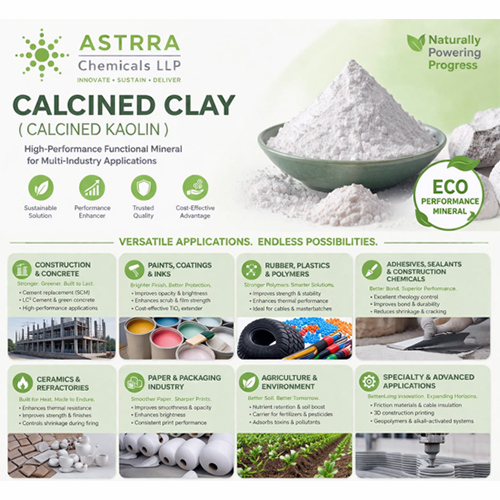
Tell us about your requirement

Price:
Quantity
Select Unit
- 50
- 100
- 200
- 250
- 500
- 1000+
Additional detail
Mobile number
Email

More Products in Industrial Chemical Category
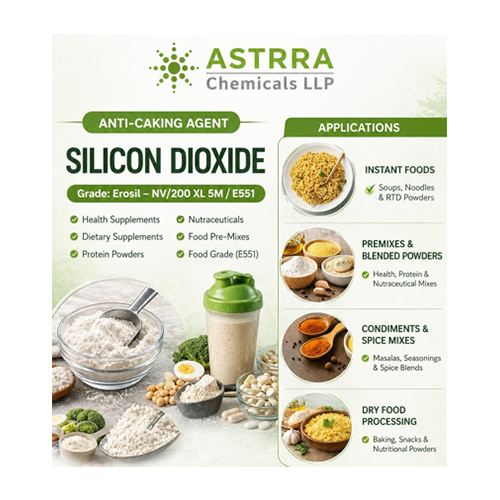
Silicon Dioxide Anti Caking Food Agent
Price 265.0 INR / Kilograms
Minimum Order Quantity : 50 Kilograms
Molecular Formula : SiO2
Taste : Other , Odorless, tasteless
Classification : Other, Anticaking agent
Storage : Other, Store in dry place
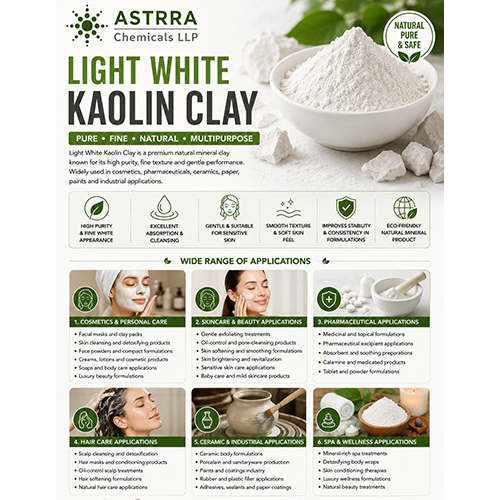
Light White Kaolin Clay
Minimum Order Quantity : 10 Pieces
Molecular Formula : Al2Si2O5(OH)4
Taste : Other , Earthy (not for ingestion)
Classification : Other, Natural Hydrated Aluminium Silicate
Storage : Other, Store in dry, cool place, sealed container
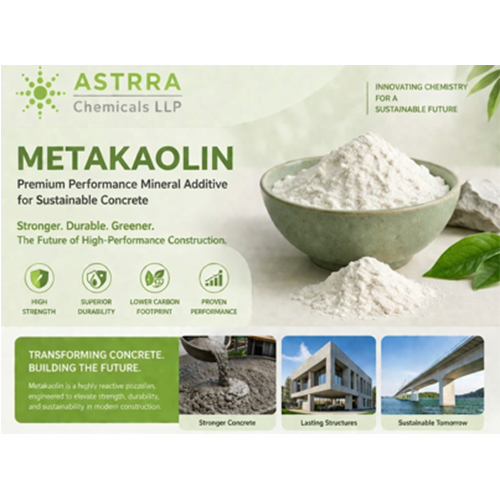
Metakaolin Powder
Minimum Order Quantity : 10 Kilograms
Molecular Formula : Al2O32SiO2
Taste : Other , Odourless, tasteless
Classification : Other, Aluminosilicate
Storage : Other, Store in a dry, cool place away from moisture
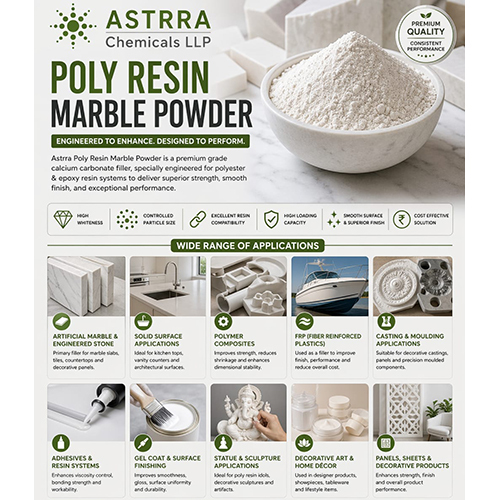
Poly Resin Marble Powder
Minimum Order Quantity : 100 Kilograms
Molecular Formula : Not applicable (polymer blend)
Taste : Other , Odorless, not for consumption
Classification : Other, Polymer composite
Storage : Other, Store in a cool, dry place away from direct sunlight

 Send Inquiry
Our Products


No 532/1, B3 & B4, Vanagaram Road, Athipet, Ambattur, Chennai - 600058, Tamil Nadu, India

Mr Sanklesh Fatechand Chabria
(Managing Partner)
Mobile :08071790210
 Send Inquiry
Developed and Managed by Infocom Network Private Limited.
