
Call us now :08071790210
 Send Inquiry
 Send Inquiry
Rice Husk Ash RHA
MOQ : 10 Kilograms
Rice Husk Ash RHA Specification
- Structural Formula
- SiO2
- Density
- 0.7 Gram per cubic centimeter(g/cm3)
- Melting Point
- ~1550C
- Refractive Rate
- 1.46 - 1.55
- Shape
- Amorphous Powder
- Smell
- Odorless
- Taste
- Odorless, Tasteless
- Purity
- >92% SiO2
- Molecular Formula
- SiO2
- Poisonous
- No
- Form
- Fine Powder
- Storage
- Store in dry, cool places
- Ph Level
- ~7-8
- Solubility
- Insoluble in water
- Other Names
- RHA, Rice Husk Silica Ash
- HS Code
- 26219010
- Molecular Weight
- 60.08 g/mol
- Classification
- Inorganic Silica Compound
- Chemical Name
- Rice Husk Ash
- CAS No
- 7631-86-9
- EINECS No
- 215-687-4
- Grade
- Industrial Grade
- Standard
- IS 1737:1964
- Type
- Powdered Ash
- Usage
- Additive in cement, Insulating material, Soil stabilizer, Industrial raw material
- Main Material
- Silicon Dioxide (SiO2)
- Application
- Other
- Non Toxic
- No
- Al2O3 Content
- <1%
- Shelf Life
- 12 months from manufacture
- Bulk Density
- 200-300 kg/m3
- Loss on Ignition (LOI)
- <5%
- Packaging
- 25 kg, 50 kg, jumbo bags
- Specific Surface Area
- 180-250 m2/g
- Sio2 Content
- >92%
- Color
- Light grey to off-white
- Particle Size
- 45-150 micron
Rice Husk Ash RHA About
Processed Pulverized Rice Husk Ash (RHA)
|
High Reactivity Pozzolanic Additive for Concrete & Infrastructure
Key Highlights:
|
High Reactivity Pozzolanic Additive for Concrete & Infrastructure
Key Highlights:
- High Silica (85-95%)
- Ultra-fine processed powder
- Excellent pozzolanic reactivity
- Eco-friendly & sustainable
- RMC / HPC Concrete
- Roads & Pavements
- Marine Structures
- Precast Blocks & Products
- Mortars & Plasters
- Soil Stabilization
- Higher strength & durability
- Reduced permeability
- Improved chemical resistance
- Less cracking & heat
- Better corrosion resistance
- Reduce cement usage
- Lower CO2 emissions
- Sustainable construction solution
Key Applications and Benefits
Rice Husk Ash LLP is prized in the construction industry as a pozzolanic material, cement additive, and soil stabilizer, significantly enhancing strength and durability. It also serves as an excellent insulating material in refractory linings and as an industrial raw material. With its high silica content and amorphous structure, it contributes to improved workability and longevity of finished products.
Superior Quality and Standards
Our RHA is produced under stringent quality control, ensuring a SiO2 purity of over 92% and low loss on ignition (<5%). Manufactured in India, it meets the IS 1737:1964 standard, guaranteeing consistent industrial-grade performance. The ash is delivered in powder form and conforms to international chemical and physical specifications.
Safe Handling and Storage
Rice Husk Ash LLP is non-toxic, non-poisonous, and odorless. For best results, store the product in dry, cool conditions, away from moisture. Proper storage safeguards its fine powder form and reactivity, ensuring up to 12 months of shelf life from the date of manufacture.
FAQ's of Rice Husk Ash RHA LLP:
Q: How should Rice Husk Ash LLP be used in cement or concrete applications?
A: To utilize Rice Husk Ash LLP in cement or concrete, simply replace a percentage of the cement content-typically 10-20%-with RHA. Mix thoroughly to achieve even dispersion, which enhances the material's strength, durability, and pozzolanic properties. Always follow the guidelines specific to your project requirements.Q: What advantages does RHA offer over other silica sources?
A: Rice Husk Ash LLP offers high SiO2 content (over 92%), a fine amorphous powder structure, and a high surface area, making it a superior pozzolan and filler. Its renewable agricultural origin and chemical stability provide both performance and sustainability benefits compared to conventional silica sources.Q: When is Rice Husk Ash typically added during the construction process?
A: RHA is generally introduced during the mixing phase when preparing cement, concrete, or mortar. This early integration ensures that it reacts adequately with calcium hydroxide to form additional binding materials, thereby improving mechanical and durability characteristics.Q: Where is Rice Husk Ash produced and supplied from?
A: Our Rice Husk Ash LLP is manufactured, supplied, and exported from India, adhering to domestic and international standards. The product is available for global shipment in various packaging sizes to meet diverse industrial and project requirements.Q: What is the process behind manufacturing Rice Husk Ash LLP?
A: RHA is produced by controlled combustion of rice husks at suitable temperatures to ensure low carbon residue (<5% LOI) and optimal amorphous silica content. The ash is then finely milled and sieved to achieve a uniform particle size of 45-150 microns before packaging.Q: What are the main benefits of adding RHA to construction materials?
A: Incorporating RHA into construction materials increases compressive strength, reduces permeability, and enhances resistance to chemical attacks. Its pozzolanic activity contributes to long-lasting and environmentally friendly structures.Q: How should Rice Husk Ash be stored to maintain its quality?
A: Store RHA in dry, cool, and moisture-free conditions using its original sealed packaging. Proper storage ensures the product retains its chemical reactivity, fine powder form, and effectiveness for up to 12 months after manufacture.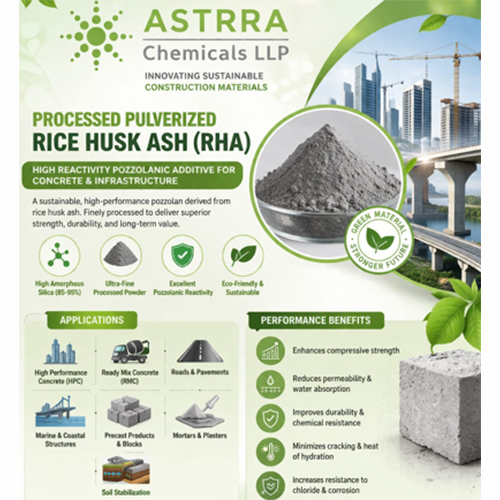
Tell us about your requirement

Price:
Quantity
Select Unit
- 50
- 100
- 200
- 250
- 500
- 1000+
Additional detail
Mobile number
Email

More Products in Industrial Chemical Category
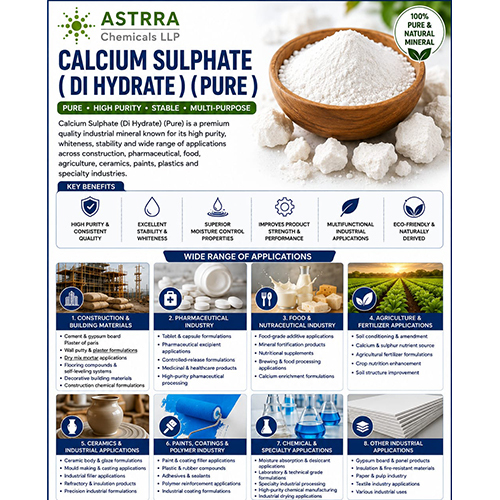
Calcium Sulphate DiHydrate
Minimum Order Quantity : 10 Kilograms
Solubility : Slightly soluble in water, insoluble in ethanol
Usage : Food additive, laboratory reagent, plaster, drying agent, soil conditioner
Other Names : Gypsum, Drierite
Non Toxic : No
Form : Solid
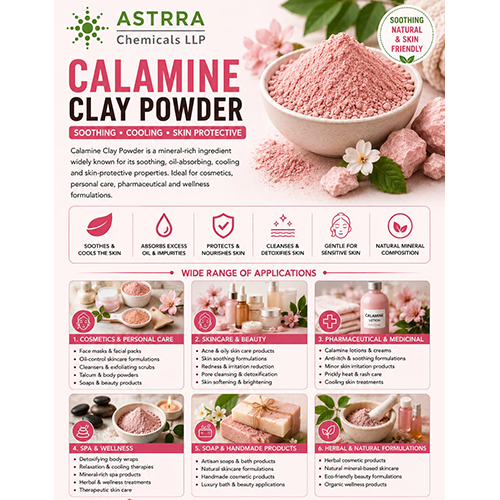
Calamine Clay Powder
Minimum Order Quantity : 5 Kilograms
Solubility : Insoluble in water, partially soluble in acids
Usage : Topical soothing, antiitch
Other Names : Pink clay, calamine powder
Non Toxic : No
Form : Powder
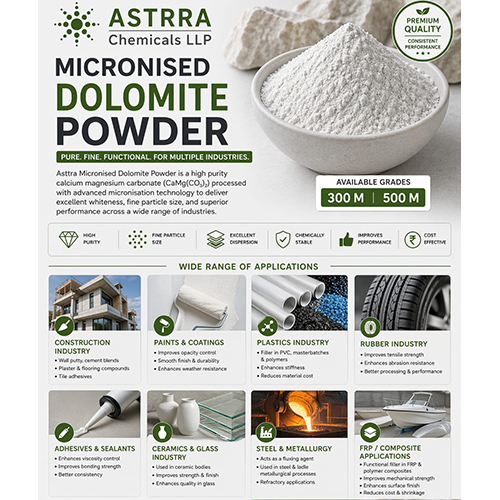
Micronised Dolomite Powder
Minimum Order Quantity : 50 Pieces
Solubility : Slightly soluble in water, soluble in dilute acid
Usage : Filler, Extender, Soil Conditioner, pH Regulator
Other Names : Dolomitic Limestone, Dolostone
Non Toxic : No
Form : Other, Micronised powder
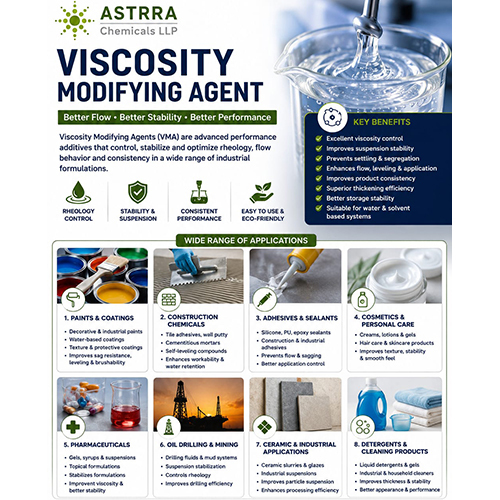
Viscosity Modifying Agent
Minimum Order Quantity : 100 Kilograms
Solubility : Easily dispersible in water, forms viscous solution
Usage : Used to control viscosity and stability of aqueous solutions
Other Names : VMA, Viscosity Modifier
Non Toxic : No
Form : Other, Powder and liquid forms available

 Send Inquiry
Our Products


No 532/1, B3 & B4, Vanagaram Road, Athipet, Ambattur, Chennai - 600058, Tamil Nadu, India

Mr Sanklesh Fatechand Chabria
(Managing Partner)
Mobile :08071790210
 Send Inquiry
 Call Me Free
Developed and Managed by Infocom Network Private Limited.
